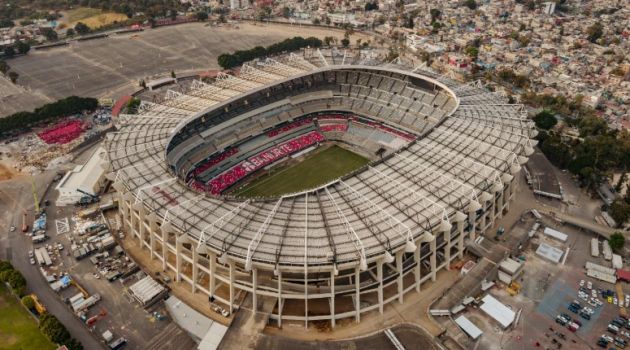
There has never been a World Cup like the one about to unfold. That isn’t the usual marketing copy you read in the run-up to every tournament, recycled with a fresh date and a new official ball. It’s a literal statement of fact. From 11 June, when Mexico face South Africa at the Estadio Azteca, until 19 July, when whoever survives the gauntlet lifts the trophy at MetLife Stadium just outside New York, football is about to take place at a scale and across a geography it has simply never attempted before.
Three host nations. Sixteen cities. Forty-eight teams. One hundred and four matches. Thirty-nine days. The numbers, written down, start to feel almost abstract. But the consequences for the football itself — for how the tournament is going to feel, who is going to win it, and how anyone reading the tea leaves should approach their predictions — are very real, and very strange, and very different from anything that has come before.
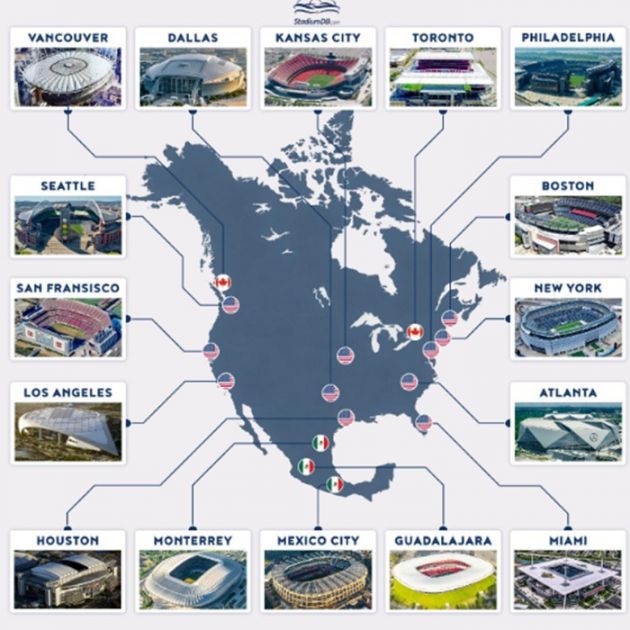
Start with the map. The 2026 World Cup will be played across roughly four million square miles of North America, from the Pacific edge of Vancouver to the Atlantic shore at Foxborough, Massachusetts, from the high plateau of Mexico City to the snow-capped Rockies behind British Columbia. The travel implications alone are dizzying.
Consider what a team’s path through the group stage might look like. A side handed the right draw — in the Eastern cluster of Atlanta, Boston, Miami, Toronto, Philadelphia and New York/New Jersey — could conceivably play three group games without crossing more than a couple of time zones. A side handed the wrong draw could find itself flying between Mexico City, Seattle and Kansas City inside ten days, a routing that would punish most professional teams on logistics alone, before a ball is even kicked.
FIFA, to its credit, tried to soften the blow. The 16 host cities were grouped into three regions — Western, Central, and Eastern — and most teams will play their group matches within a single cluster. But the moment the knockout rounds begin, that geographical mercy disappears. A team that tops its group in Vancouver could easily find itself playing its Round of 32 fixture in Atlanta, four time zones and four thousand miles away. Whoever lifts the trophy in New Jersey on 19 July will, in many cases, have crossed the continent more than once on the way.
That sprawl creates a problem the football world has rarely had to think about so seriously: climate. The 2026 World Cup will be played in June and July across a continent that contains some of the most extreme summer weather on earth.
Dallas in late June regularly sees temperatures past 38°C. Houston is humid in a way anyone who has ever stepped off a plane there understands inside thirty seconds. Mexico City sits at over 2,200 metres above sea level, an altitude that has historically reduced visiting teams to gasping shadows of themselves by the second half. Vancouver, by contrast, is mild, coastal, and entirely pleasant. Toronto can land anywhere between perfect and miserable depending on the week.
The point isn’t that these conditions are dangerous, although in some cases they very well may be. The point is that they’re staggeringly different from one another. At Qatar 2022, every match was effectively played in the same conditions: hot, dry, indoors-or-air-conditioned. In 2026, a team could play its first group match at 38°C in Texas, its second at altitude in Mexico, and its third at a balmy 19°C on the Pacific coast. No previous World Cup has asked that kind of physiological adaptability of its competitors, and there is no clean historical record to lean on for which teams handle it best.
If the geography is one revolution, the format is another. The decision to expand the World Cup from 32 teams to 48 — ratified by FIFA back in 2017 and finalised in its current shape in March 2023 — is the biggest structural change to the tournament since 1998. And it isn’t just an extra handful of matches bolted onto the side of the old structure. It changes the architecture of the whole event.
Here is how it works. The 48 teams are split into 12 groups of four. The top two from each group go through, plus the eight best third-placed sides, giving you 32 teams in the knockout rounds. That extra wrinkle — a Round of 32 that has never existed at a men’s World Cup before — sits in front of the familiar Round of 16, and it changes the calculus of the tournament in ways that haven’t fully sunk in yet.
For one thing, finishing third is no longer a death sentence. Smaller nations who would previously have packed up and gone home after losing two of three group games now have a real route into the knockouts. For another, the path to the final is eight matches long instead of seven, which is a meaningful additional load on tired legs and creaking hamstrings — particularly in the climate conditions described above.
There is also a more subtle effect on tactics. In a 32-team tournament, group stage football tends to be cautious. With 16 of 32 going through, you can comfortably afford to draw your first match. In a 48-team tournament, with 32 of 48 advancing and a third-place safety net underneath that, the incentives shift. We are likely to see more open, attacking group-stage games than we have in years — which, for fans, is unambiguously good news.
The expansion has scrambled the predictive picture in ways the football media is only beginning to grapple with. More teams means more variance. More variance means a wider range of plausible outcomes. More plausible outcomes means that, statistically speaking, the tournament is more likely to produce a genuine surprise winner than any World Cup since the format settled at 32 teams almost three decades ago.
That is why anyone serious about football matches predictions for world cup 2026 is having to rebuild their models from the ground up. The previous statistical reference points — historical group-stage performance, knockout win rates against particular continental opponents, head-to-head records in tournament conditions — were all built on a 32-team frame. They don’t translate cleanly to a 48-team event with an extra knockout round and unprecedented travel demands. The platforms producing genuinely useful match-by-match forecasts this summer are the ones treating 2026 less like the next instalment of a familiar event and more like a new tournament that happens to share a name with the old one.
There is also simply more to predict, in the most literal sense. One hundred and four matches is more than 60 per cent more football than fans got at any previous World Cup. The group stage alone will deliver 72 fixtures, many of them between teams that will barely have scouted each other in any meaningful depth. For supporters who enjoy watching a tournament evolve — backing a debutant, tracking which dark horses are staying lively, looking for value the bookmaker hasn’t spotted yet — the volume of action on offer is unlike anything the sport has ever delivered.
Hosts have a peculiar advantage in international football. Crowds, climate familiarity, no jet lag, and home media coverage that frames every result as the start of something special. In 2026, three different teams will get to enjoy that boost, in three very different ways.
Mexico, opening the tournament at the Azteca on home soil, will arrive carrying decades of World Cup memory and the deafening backing of one of football’s most passionate fan bases. Canada, hosting men’s World Cup matches for the first time in its history, gets to ride a wave of unprecedented domestic interest with matches in Vancouver and Toronto and a young squad that has been quietly building toward this moment for years. The United States, with by far the most matches and the final itself, will lean on the kind of organisational firepower the country brings to every major sporting event, plus a national team that has improved markedly since its early exit in Qatar.
None of the three is a serious favourite for the trophy. But all three have meaningful paths into the deep stages of the knockouts, and all three are operating in conditions tilted in their favour. In a tournament this open, that matters considerably more than it would in most years.
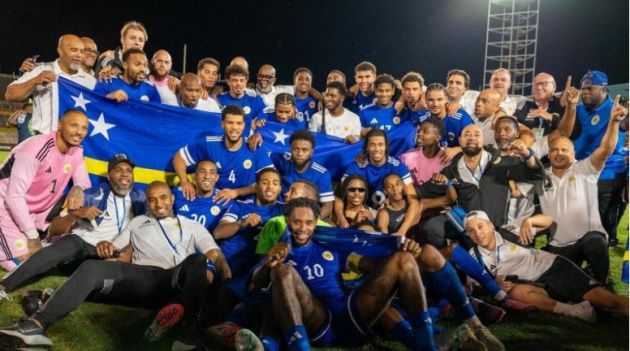
For all the talk of formats and forecasts, the human stories are where this World Cup is going to live. Two of them, on opposite sides of the world and at opposite ends of the football food chain, capture what the new tournament actually means.
The first is Curaçao. The Caribbean island, an autonomous territory inside the Kingdom of the Netherlands with a population of roughly 156,000 people — fewer than would fit inside MetLife Stadium twice over — has qualified for its first ever World Cup. By doing so, it has become the smallest nation by population ever to reach the tournament, breaking a record set by Iceland in 2018 with a population of around 350,000. The squad is built largely around dual-national players raised in the Netherlands, and includes footballers from Rotherham in the English third tier, Bandırmaspor in the Turkish second division, and Abha in Saudi Arabia. Their manager, Dick Advocaat, is a familiar name from the European game — a 78-year-old veteran who has previously coached the Netherlands, South Korea, Belgium and Russia. The fact that he is now leading a Caribbean island of 156,000 people to a World Cup is, on its own, the kind of story football’s biggest tournament was supposedly built to tell.
The second is Italy. The four-time World Cup winners, who lifted the trophy as recently as 2006, will not be in North America this summer. They will not be there for the third tournament in a row, a sequence no former champion has ever endured. Their qualification campaign ended on a cold March night in Zenica, where they led 1–0 against Bosnia and Herzegovina before having Alessandro Bastoni sent off, conceding a late equaliser, and finally losing the play-off final on penalties. By the time the opening whistle blows in Mexico City, Italy will have gone 16 years without playing a single World Cup match. Their current head coach, Gennaro Gattuso, was on the pitch the last time they played one — the 2006 final win over France in Berlin. Now he is the man who couldn’t reach the next one.
These two stories — one of joyous improbability, one of dynastic decline — sit at the heart of what makes this tournament’s expansion meaningful. Cape Verde, Jordan and Uzbekistan will all make their World Cup debuts alongside Curaçao. DR Congo are back at the tournament for the first time since 1974, Iraq for the first time since 1986, the Czech Republic for the first time in twenty years. Qatar, who appeared in 2022 only because they were hosting, have qualified through the proper channels for the first time. The list of nations not in this year’s tournament — Cameroon, Costa Rica, Wales, Poland, Denmark, Serbia, Italy — is almost as striking as the list of debutants and returners. The hierarchies football fans grew up with are not quite holding the way they once did, and the wider draw is starting to look more like the wider game.
Every World Cup ends up being remembered for something nobody saw coming. South Korea’s run to the semi-finals in 2002. Saudi Arabia beating Argentina in 2022. Croatia, twice now. Morocco’s astonishing 2022 campaign. Germany’s 2018 collapse. These were not storylines anyone walked into the tournament expecting, and they each reshaped how football understood itself afterwards.
In 2026, with more teams, more matches, more travel, and a brand-new format that nobody has actually played through yet, the odds of a genuinely unprecedented storyline are higher than they have ever been. With 32 of 48 teams advancing into the new Round of 32, smaller nations who would historically have packed up after losing two of three group games now have a real route into the knockout phase. By the time the tournament reaches its final week, the names left standing may well include at least one country that nobody, anywhere, was talking about in early June.
That is the thing about expansion. It doesn’t just add more teams. It opens more room for stories, and football, more than any other sport, is fundamentally a sport about stories.

So here we are. Three countries, sixteen cities, forty-eight teams, one hundred and four matches, and a continent’s worth of contradictions to navigate before anyone holds a trophy aloft in New Jersey on 19 July. The bookmakers have a favourite. The pundits have theirs. The data, for what it’s worth, suggests the field is more open than it has been in a generation. And underneath all of that, somewhere in the calendar between the opening whistle in Mexico City and the final whistle at MetLife, an entirely new chapter of the World Cup is going to write itself.
Whoever lifts the trophy on the night of 19 July will have done something genuinely unprecedented. They will have won a tournament played across three nations and roughly a dozen distinct climates, with one extra knockout round, against a wider field of opponents, after more travel and more matches than any World Cup winner before them. Whatever else 2026 ends up being, it isn’t going to be just another World Cup. It is the first of a new kind. And we get to watch it happen.
The post Three Countries, Forty-Eight Teams, One Trophy: Inside the Most Ambitious World Cup Ever Staged appeared first on Juvefc.com.