
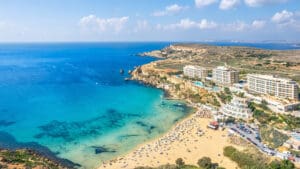
Yet, beneath this success, the island has become somewhat of a battleground for persistent debates, legal disputes and public controversies. As developers push forward with ambitious projects, critics and NGOs continue to raise concerns about their environmental, social, and cultural impacts. Ahead, we spotlight the three developments which sparked the fiercest battles in Malta’s development scene.
Anton Camilleri’s Villa Rosa project has provoked significant public backlash in recent times, drawling criticism from local councils, activist organisations and environmental non-governmental organisations (NGOs) alike. In 2025, Camilleri unveiled a renewed draft plan for the site, envisioning a 146,500-square-metre development comprising a hotel, commercial areas, retail, and catering facilities which would be spread across three towers.
Environmental NGOs have been particularly vocal in their opposition, warning that approval of the project would ‘disfigure’ Malta’s coastal landscape. The coalition of hostile NGOs, including Moviment Graffitti, Din l-Art Helwa, and BirdLife Malta issued a statement arguing that there was ‘no credible justification’ for increasing the project’s scope. They also criticised the absence of evidence showing a tourism shortfall in Malta or that high-rise hotels would, in fact, attract ‘high-quality tourism,’ noting as well that no environmental, social, or economic impact assessments had been submitted.
This is not the first time the Villa Rosa development has faced setbacks. In December 2024, an initial permit for the Villa was rescinded due to the developer’s failure to ‘follow site notice procedures.’ Moviment Graffiti lodged the appeal, highlighting that ‘site notices were not affixed on one side of the project site and did not include the names of all the access roads next to the project.’ Indeed, the relentless opposition from prominent voices in Malta’s civic and development spheres underscores why Villa Rosa clearly warrants a place among the country’s most controversial projects.
Whilst Paul Gauchi, owner of Villa St Ignatius, was ultimately cleared of wrongdoing in a court case over the St Ignatius project, the very fact that the case reached the courts makes it a noteworthy entry on this list of controversial developments.
For context, developer Paul Gauci acquired the 19th-century historic villa in Sliema, with plans to redevelop it into a four-star hotel. NGO Din L-Art Helwa protested, arguing that parts of the building were demolished in violation of a 2017 court order requiring roof repairs by the previous owners. Furthermore, the NGO also contended that the planned redevelopment threatened the villa’s historic fabric and as a result, they had no option but to pursue their protest in court.
However, in a damning judgement levied against the NGO in October 2025, Justice Vella Cuschieri ruled that Din L’art Helwa had no legal authority to file the case in the first instance, as Gauci was not bound by the original court order dating back to 2017. The Planning Authority amplified these criticisms, accusing the NGO of ‘misusing its platform to target individual public officers’ and warning that such actions could undermine the effectiveness of enforcement staff acting in the public interest.
Corinthia Group’s Hal-Ferħ Project: Public Land but Private Gains
The Corinthia Group Hal-Ferħ scandal has been unfolding since October 2021, when The Shift first revealed that Corinthia Group, a Maltese hotel developer, would be parting with just $1.3 million for 30,600 square metres of public land – far below the $10.3 million originally expected for a site enjoying exclusive views over Golden Bay.
The project departs significantly from the 2012 permit previously granted for the area. Rather than the 228 tourism and timeshare units initially approved, Corinthia Group instead proposed the building of a luxury resort complex consisting of a hotel with 122 rooms and 39 suites alongside a residential zone spanning accommodating 25 high-end villas.
Critics have voiced sharp criticism of the deal, arguing that not only was valuable public land sold at a heavily discounted price, but that the terms under which Corinthia acquired the land were ‘scandalous’ and potentially ‘illegal.’ The damning allegations, reported by The Shift, posits that whilst the hotel developers would pay $1.3 million upfront, the remaining €9 million would be financed through the sale of the villas, paid incrementally each time a property sold.
Legal sources suggested that the agreement could have breached EU state aid rules, raising questions over ‘unfair competition, below-market prices and advantageous payment terms.’ Indeed, critics argue that if the revised permit terms had been publicly known in advance, other developers might have submitted competing bids for the land. Despite the absence of a formal investigation into these allegations, Corinthia’s Hal-Ferħ project has clearly been mired in controversy since its inception.
The project has not escaped debate in more recent times either. In 2025, the Environment and Resources Authority (ERA) raised three principal concerns regarding the development. These included the potential for a major adverse impact on landscape and visual amenity, significant impacts resulting from the removal of geological material, and moderate impacts on fauna caused by artificial lighting.
Although the ERA ultimately issued clearance subject to certain conditions, and in February 2026 the project was recommended for approval by the Planning Authority, the anticipated environmental impacts have nonetheless generated frustration and criticism on social media. Notably however, no major NGOs such as Moviment Graffiti or Din L’art Helwa have formally appealed or protested the Hal-Ferħ development.
Read more:
Controversy in Malta: the three projects causing uproar.