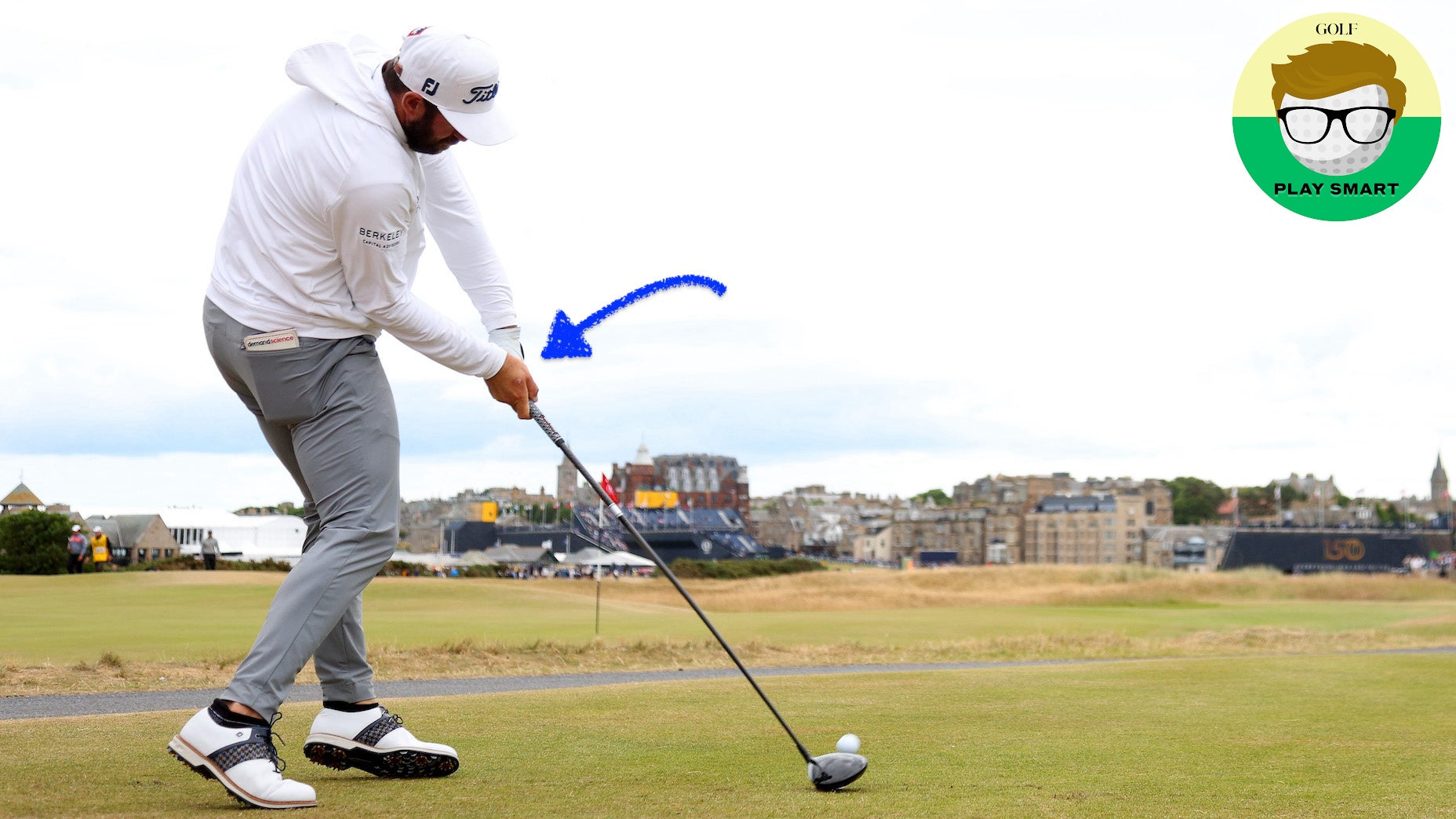
For so, so many years I have plateaued as a high, single-digit handicap. Right in the 8-9 range, occasionally playing like a 10. The reason was clear to anyone who played with me: that boy has speed, but man that driver can get loose.
With that one word — loose — you can imagine the visuals: high, right and gone.
To keep explaining, I’ll need to drop the humility for a sec. I am athletic. I have good hand-eye coordination. I grew up on baseball, basketball, football, you-name-it ball. Hence the swing speed — 110 to 113 mph with driver, just beneath Tour average. And the contact is often around the center. Not perfect, no. But sometimes perfectly right out of the center of the face. And though that should produce a good result, sometimes the center hits were the ones landing farthest from the fairway. I spent years buried in the resulting confusion.
My problem with all that speed was that I wasn’t being patient enough to use it. I wasn’t giving myself enough time to finish the backswing before my legs, hips and core fired ahead of my arms and hands. My upper and lower body were trying so hard to get in sync right before contact rather than be in sync at some point earlier in the downswing.
I created some natural lag and plenty of torque, but struggled with a steep downswing — those hands rushing to the contact zone — because of a too-quick tempo. What I’ve learned is … this is one of the hardest things to fix. One coach stood behind me and held the clubhead at the top of my swing to make sure I got to that point and paused — for just a split-second — before firing at the ball. This helped diagnose the issue, of course. High-speed cameras would show how my hip rotation rarely synched with my shoulder rotation. But over time, without that coach on the driving range with me, bad habits seeped back in.
The ingenious idea Cameron Young’s dad used to create one of golf’s best swings
So what gives? Why, dear reader, should you keep reading through the trials of a golfer you barely know?
Because your own payoff might be similar. You might be as visual of a learner as me.
That’s part of the deal, right? If crafting a new, repeatable part of your swing is, at least partly a self-taught exercise, then we all need to tap in to what kind of learners we are. I am decidedly not a kinesthetic learner. I am much more a visual understander of the world. I needed to take notes in college, simply to write things down so I could see them on the page rather than hear them from my professor’s lips.
All of that is to say, I need images. I need those high-speed cameras. In order to figure myself out, I also needed a visual swing thought. Which is why I spent most of 2025 thinking about Hideki Matsuyama and Cameron Young.
The most avid golf fans know that these two players share one swing element in common more than any other: they pause at the top of their backswing in such a way that you can’t seem to see anything else. Every part of their swing seems to revolve around that pausing point, like a fulcrum keeping everything in balance. Both swings are fast and violent, but they are patient. And I channeled them throughout 2025.
No, I don’t have a pause in my swing like Young or Matsuyama. That’s because feel is different than real. How it all looks, to my various playing partners, is something a lot more fluid. But in my head there is a forced patience during the last 10% of my backswing. I am thinking about reaching my Cam Young Point before pulling my hands back down to the ball. Just the image, burned into my tee ball conscience — much like the one atop this article — has made for better contact and actually feeling more control in the hitting area, which makes sense. My lower body and upper body feel more in sync during the downswing. I reach a place of synchronicity earlier than ever before, and that allows my hand-eye coordination to take over.
What does it look like, results-wise?
The big, high, right miss has mostly been banished, through the sheer fact that my natural swing — cutting slightly across the ball — has me starting everything on the left edge of the fairway and bleeding softly back right. The more patient swing is a much shallower swing, too. More shallow means less movement in the hitting zone and less spin, always a good thing with the longest club in the bag.
So, what’s the takeaway, here on Dec. 31?
Take an online test to learn what kind of learner you are. Then find a fix that fits that learning style. For the visual folks out there, a simple photograph might do the trick. For the audio-types, maybe it’s whispering your swing thoughts over the ball. The kinesthetic learners might need to groove muscular repetitions for a few hours before feeling confident in them. And if you’re a combination of multiple learning types, maybe you’ll be rehearsing moves in front of a mirror. Here’s a quiz to help get you started on that journey.
The post The best thing I used in 2025 was a single, simple image appeared first on Golf.