
The honest answer, I have realised over the intervening twelve months, is that the most important and most fragile thing we could do is keep the village pub open. I have been thinking about this, since the spring, almost every day. So allow me, this week, the personal column. I think it is the right week for it.
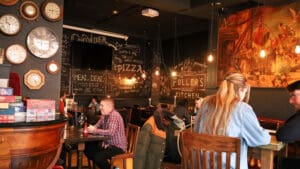
The pub I am writing about, and yes, of course it is a particular pub, is in a small village in Suffolk, on a road that the satnav lies about. It has been there in some form since the 17th century. The current building is largely Georgian, with a Victorian extension and a 1990s kitchen that I would generously describe as character-building. The current tenant has been in place for eleven years. The previous tenant for twenty-three.
It is, by the present trade body’s definition, a “community wet-led” pub. About 60 per cent of its trade is drinks; 30 per cent is food; the remainder is the upstairs rooms, which were converted in the 1990s for the kind of weekending Londoners we used to call “townies” and which we now call, less affectionately, “zoom refugees”. It employs four full-time and seven part-time staff. The full-time staff include the chef, who came up from Hackney during the pandemic and never left, and a young lad of 22 who started as a glass-collector five years ago and has just qualified as cellar-master. The part-time staff are mostly women from the village, two of whom would, in a different country, be working in a primary school that closed in 2019.
It is the wettest, most stubbornly British piece of social infrastructure I know, and it is, on the present rates revaluation, in a kitchen-equipment-replacement cycle that nobody saw coming, and in a year of unusually aggressive energy contracts, about £42,000 a year away from solvency. This is not a private detail. The publican, when I rang him on Monday, told me himself.
There are, in our village, no shops. There has been no post office for fourteen years. The bus runs twice a week. The primary school, in 2019, lost its Year 6 cohort permanently. The doctor’s surgery closed for new patient registrations in 2018 and is, now, more of a dispensing arrangement than a clinic. The church holds services once a fortnight. The mobile library, which had one stop here on a Tuesday afternoon, was wound up in the funding round of 2022. The pub is, in any meaningful sense, what the rest of the village now is.
Were it to close, the geography of village life would not be replaced by something else. There is no shop ready to take over the “community” function. There is no village hall with a working kitchen, it lost its Aga in 2017 and the trustees never raised the £6,200 to replace it. The Cubs, who use the pub’s back room on Wednesdays, would, on past form, drift to a town six miles away and, on past form, shrink. The Sunday lunches, which give an unmarried woman of 78 her main weekly social contact, would not happen. The wakes, and we have had four, this year, in a village of 273, would have to be held in someone’s living room.
I am aware, as I write this, of the metropolitan eyebrow being raised. The countryside has been moaning, the eyebrow says, for as long as anyone can remember, and the countryside is not what it once was. Both of those things, technically, are true. They are also evasions. The countryside is materially different from any other part of England in one specific respect: when its institutions go, there is, almost without exception, no replacement. London has, in any one square mile, three public houses, four cafés, a couple of pubs that aren’t very good, several restaurants and a handful of community spaces that do roughly the same social work between them. Suffolk does not. The English village, almost uniquely in the British Isles, has put all of its community infrastructure into a single building, and that building, increasingly, is the pub.
What would I, accordingly, do? Almost everything I have already proposed in this magazine: VAT at 12.5 per cent for hospitality; a community-pub-specific multiplier on rates; the “asset of community value” reform with the burden of proof reversed onto developers seeking to flat-pack a Grade II listed pub. Plus one more, which I have been quieter about until now: a small, ring-fenced national fund, perhaps £150 million a year, to provide low-interest loans to community pub buyouts in areas where the only alternative is closure. We have such a fund for cinemas. We have a far larger one for football. We do not, anywhere in our policy stack, have one for the rural pub.
We will know, in two or three years, whether we kept these places open. I’ll be in the Suffolk one as long as it’s open. So will, on present form, the village. The country, very quietly, would be better for the same.
Read more:
I worry for the rural pub, and yes, this one is personal too