There is the card terminal lease or purchase, the transaction fees on a separate billing platform, the staff time spent reconciling payments against invoices, and the revenue lost when patients leave without settling a balance. Add it up across a year, and the number tends to be uncomfortable.
WriteUpp Pay turns an iPhone or Android device into a contactless payment terminal using built-in NFC technology, pulling appointment and invoice data directly from WriteUpp to process payments at the point of care. No card reader. No hardware purchase. No separate reconciliation process.
For solo practitioners and small clinic owners operating on tight margins, the proposition is direct. Your phone is already in your pocket. It can now take payments.
The cost of accepting card payments in a small healthcare practice is rarely limited to the visible transaction fee. Traditional card terminals require either an upfront purchase or a monthly lease agreement. Payment platforms that sit outside the practice management system create reconciliation work. Invoices that go home with patients and are settled days later extend the payment cycle and create cash flow gaps.
Visa data shows that Tap to Phone adoption surged by 320 percent in the UK in 2025, driven largely by small businesses seeking to reduce hardware dependency and simplify payment acceptance. The trend reflects a broader recognition that the tools required to accept card payments have become unnecessarily complicated and expensive for businesses that do not need enterprise-level infrastructure.
WriteUpp Pay addresses this directly. Because the app is built on Stripe’s infrastructure and connects to an existing WriteUpp account, there is no additional platform fee. Stripe’s standard transaction rates apply. For a practice already using WriteUpp and Stripe for online payment collection, adding in-person payment capability requires only downloading the app and completing a brief setup.
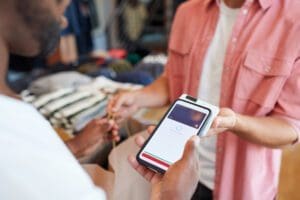
When they open the app, WriteUpp Pay shows clinicians a live list of that day’s unpaid appointments and recent invoices. They select the relevant appointment, tap to initiate payment, and the patient taps their card or digital wallet toward the top of the phone. The transaction processes in seconds. The invoice inside WriteUpp is marked as paid automatically, and a receipt can be sent to the patient by email without any manual steps.
Digital wallets, including Apple Pay and Google Pay, are accepted alongside standard contactless bank cards. Transactions paid via digital wallet carry no upper limit because biometric authentication replaces the PIN requirement, making WriteUpp Pay practical for higher-value consultations. For transactions using a regular bank card, the FCA lifted the fixed £100 national contactless cap from March 19, allowing banks to set their own limits or let customers configure their own caps going forward.
For practices using iPads or devices without NFC capability, WriteUpp Pay supports the Stripe Wisepad3 Bluetooth card reader, which connects wirelessly and processes payments through the same Stripe infrastructure. This means the app works whether a clinician is using the latest iPhone or an older tablet that lacks NFC support.
“We specifically designed WriteUpp Pay to work for practices of all sizes, not just those with large admin teams and IT budgets,” said Eric Lalonde, CEO of WriteUpp. “A solo physiotherapist should be able to take payment at the end of a session just as easily as a large multi-practitioner clinic. The phone they already carry is all they need.”
For small healthcare practices, payment timing matters. Revenue collected at the point of care is revenue that does not require chasing. Invoices sent after the fact sit in email inboxes, get forwarded to the wrong person, or simply go unpaid for longer than they should.
WriteUpp Pay removes the gap between service delivery and payment collection. When a clinician finishes a session, payment happens immediately as part of the natural end-of-appointment workflow. There is no separate step for the patient, no invoice to chase, and no administrative follow-up required. The invoice closes in real time and the revenue appears in the practice’s Stripe account without delay.
For practices that currently experience slow payment cycles, the improvement in cash flow predictability can be significant. Stripe’s standard reporting tools mean practices can track daily payment activity without logging into a separate billing system.
“Cash flow is one of the most stressful parts of running a small practice,” Lalonde said. “You have done the work, you have provided the care, but then you spend the next two weeks waiting to be paid for it. WriteUpp Pay makes that problem much smaller. Payment happens when the appointment ends, not a fortnight later.”
WriteUpp Pay is available from the Apple App Store and Google Play Store. It requires an existing WriteUpp account, a connected Stripe Unified account, and at least one location set up within the Stripe account. Clinicians log in using their existing WriteUpp credentials, complete the location setup, and the app is ready to take payments.
For practices not yet using WriteUpp, a 30-day free trial is available through the WriteUpp website. The platform starts at £19.95 per month in the UK on a rolling monthly subscription with no minimum contract, giving small practices the ability to evaluate the full platform, including WriteUpp Pay, before committing.
Read more:
How WriteUpp Is Solving the Hidden Cost of Taking Payments in Small Healthcare Practices