
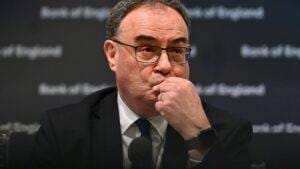
Only a week ago, markets were confident that the Bank of England would cut rates again at its March meeting, with traders pricing in an 86 per cent probability of a 0.25 percentage point reduction. Now, following military escalation involving the US and Iran and renewed instability across the Gulf region, those expectations have collapsed. Markets are currently assigning less than a 5 per cent chance of a rate cut this month and less than a 50 per cent probability of a move in April.
The Bank’s base rate currently stands at 3.75 per cent, having been reduced four times in 2025 as inflation fell to 3 per cent. Governor Andrew Bailey had previously suggested that a return to the 2 per cent target was “baked in”. However, the geopolitical shock has materially altered that outlook.
UK wholesale gas prices have surged by around 40 per cent in recent days, while oil prices have approached $80 per barrel. Two-year gilt yields have risen to their highest levels since December as markets reassess the inflationary impact of higher energy costs.
The risk, analysts say, is that sustained disruption to global energy supplies, particularly through the Strait of Hormuz, could keep inflation elevated for longer, forcing the Bank of England to pause or even reverse its easing cycle.
Tony Redondo, founder of Cosmos Currency Exchange, said the shift in expectations had been dramatic.
“With 2-year gilt yields hitting December highs due to a 40 per cent surge in UK gas prices and oil nearing $80, the Bank of England faces a significant inflationary shock,” he said. “High-street banks are no longer competing on price but are instead protecting margins against rising swap rates. Buyers may see ‘best-buy’ deals pulled with only a few hours’ notice as lenders move to price in the geopolitical risk premium.”
Swap rates, which underpin fixed-rate mortgage pricing, have risen sharply in response to higher gilt yields. Lenders typically price mortgage products several days in advance, meaning further volatility could quickly feed through into the housing market.
Riz Malik, director at R3 Wealth, warned that the situation could resemble the market turmoil seen in 2022 following Russia’s invasion of Ukraine and the UK’s mini-Budget crisis.
“Last week, the outlook was promising for the 1.8 million mortgages up for renewal in 2026,” he said. “Today, we could see major volatility in the mortgage market with the outlook for further cuts disappearing by the second. If you have a mortgage renewal in the next six months, I would strongly suggest you look at your options and don’t hold off.”
Justin Moy, managing director at EHF Mortgages, said the duration of the conflict would be critical.
“In the short term, any talk of base rate cuts will be null and void,” he said. “If the conflict resolves within weeks, this may be temporary. But if it continues beyond Easter, inflation and base rate expectations will be adversely affected, putting the brakes on rate cuts and pushing deals higher.”
Aaron Strutt, product and communications director at Trinity Financial, said uncertainty was the defining feature of the current environment.
“We do not know what is going to happen yet. Rates could go up, the war might stop and rates drop again as previously forecast. Either way, it makes sense to secure a mortgage rate if you are coming up to remortgage soon.”
Some advisers believe the situation, while serious, differs structurally from the disorderly repricing seen in autumn 2022.
Nouran Moustafa, practice principal at Roxton Wealth, said lenders are better prepared than during the Truss-era turmoil.
“Markets have moved quickly, but mortgage pricing reacts to sustained trends, not single sessions,” she said. “Back in 2022, funding costs moved disorderly and fast. Today’s move looks more like volatility driven by inflation expectations.”
She added that the key question is whether elevated yields persist. “If yields stay elevated for several days, we could see short-notice repricing or selective withdrawals. If this retraces, lenders will prioritise stability.”
The Bank of England now faces a delicate balancing act. While inflation had been easing and economic growth remains fragile, an externally driven energy shock risks reintroducing cost pressures just as policymakers were preparing to loosen monetary conditions further.
If wholesale gas prices remain elevated and oil continues to climb, rate-setters may judge it prudent to delay cuts to prevent inflation expectations becoming unanchored. That would prolong pressure on households and businesses already grappling with high borrowing costs.
For now, the direction of travel depends less on domestic economic data and more on developments in the Middle East. Should tensions subside and energy prices retreat, the easing cycle could resume. But if the conflict deepens or spreads, expectations of multiple rate cuts in 2026 may quickly evaporate.
In the meantime, borrowers and investors alike are being reminded that global geopolitical events can reshape monetary policy forecasts in a matter of days.
Read more:
Bank of England rate cuts at risk in 2026 as Middle East conflict sparks inflation fears