
What is it? Goblin stealth goes semi-open world and hugely vertical.
Release date February 19, 2026
Expect to pay $40
Developer Cyanide Studio
Publisher Nacon
Reviewed on RTX 3060 (laptop), Ryzen 5 5600H, 16GB RAM
Steam Deck TBC
Link Steam
I have a fractious relationship with the Styx series: I love its highly vertical and often punishing approach to third-person stealth, but I loathe its foul-mouthed, quippy goblin protagonist. I can't even stand the look of the bastard. Styx has made me cringe through dozens of hours of otherwise brilliant sneaking and terror-wreaking, and I guess it's saying something that I enjoyed pretty much every moment of Blades of Greed despite wanting to slug the sleazy green sod in the ear.
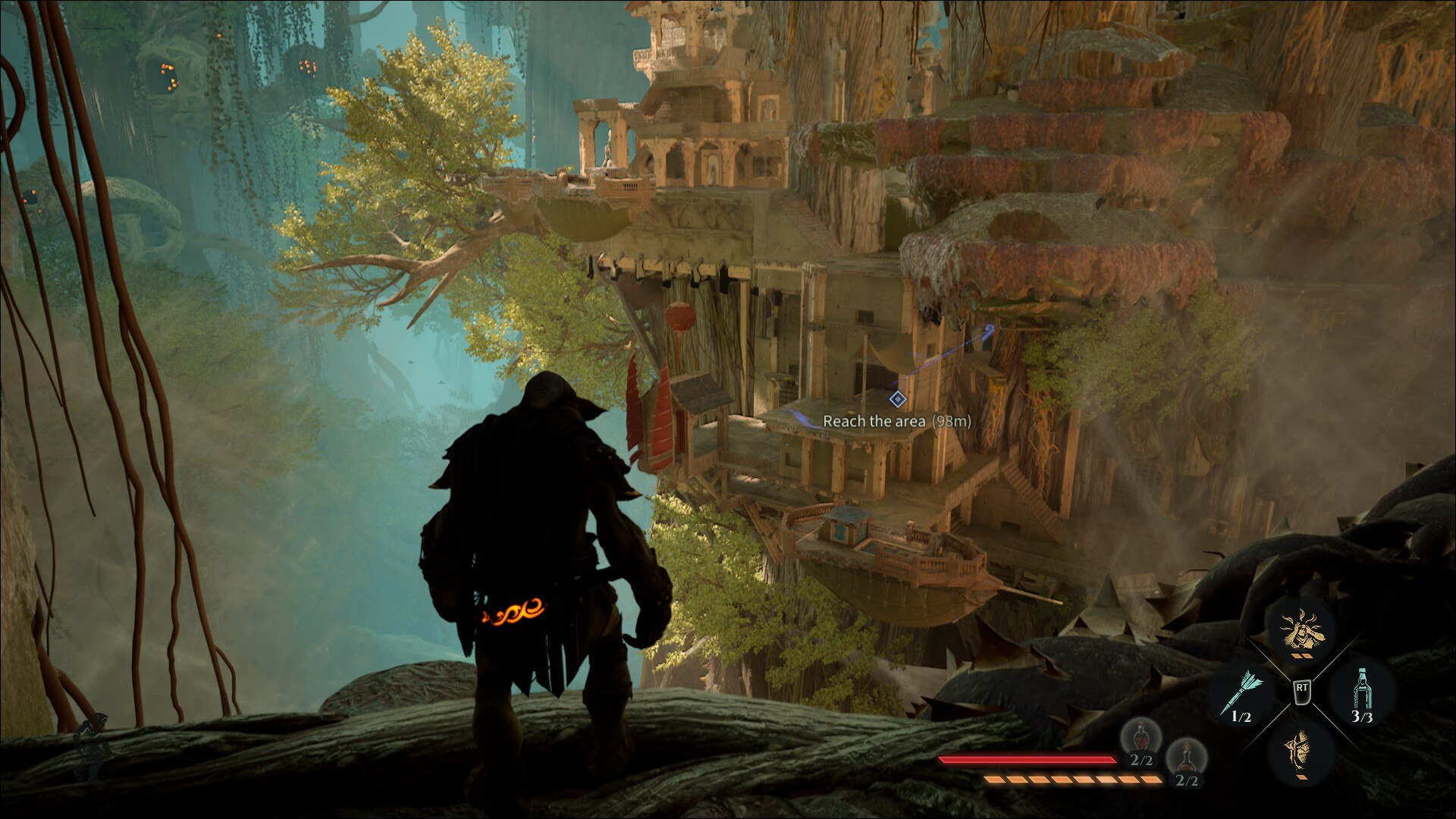
It's been nine years since the last Styx game and quite a bit has changed. Blades of Greed shifts towards an open world format, but the result is not dissimilar to the level-based design of the first two Styx games. There are three massive maps here, and all sprawl vertically to an extent that makes Dark Souls’ Blighttown look like the Sahara. I can't access everywhere immediately though, because Styx now has metroidvania-style traversal upgrades that make returning to previously visited regions hugely rewarding.
The first is a hookshot I can use to reach otherwise inaccessible heights (or accessible ones faster), and the second is a parachute for riding wind columns like elevators or breaking my fall. These and more are doled out during story beats but, as usual, Styx has a range of optional unlockable abilities too. I mostly used his returning temporary invisibility cloak, but Styx can also possess enemies, create a clone, and slow down time, in addition to some more offensive upgrades that didn't suit my playstyle.
There are a lot of RPG-lite decisions to make, but they ultimately come down to whether you like to just sneak around, or if you plan to take a more brazen approach. Either way, for most players Blades of Greed demands that direct encounters be kept to a minimum. It's possible to engage in direct combat with a foe but remember: you're a piddling goblin.
Hobnobbing
Maybe surprisingly, Blades of Greed is an utterly gorgeous game, even on medium settings. My favourite map was The Wall. It's a tumbledown multi-storeyed city built in the arches of a towering viaduct. I loved ferreting around in the upper reaches of this tenebrous ghetto, scaling heights that seem impossible or else off-bounds from afar. There's also Turquoise Dawn: a verdant, swampish expanse once the sole province of orcs, with monolithic trees and even taller strongholds. Styx even revisits the ruins of Akenash, which was destroyed in the first Styx game.
When a foe spots me I can escape up a chimney, parkour down a nearby rope, leap through the window and cut his throat from behind.
As much as the Styx games are stealth they're also basically platformers, and Blades of Greed's shift to an open world format has resulted in hugely rewarding exploration. There were a couple of occasions during my playthrough when I was pretty sure I was sequence-breaking the game. But no: it's always perfectly valid to shuffle dangerously along a wall above a sheer drop rather than take the stairs, and there's always probably a couple of other routes to take as well.
The maps are designed like sprawling honeycombs, and this is most obvious when I have to make a quick escape: crawlspaces connect chambers, which are also connected by rooftops, windows, corbels and pilasters. When a foe spots me I can escape up a chimney, parkour down a nearby rope, leap through the window and cut his throat from behind. By the five hour mark Styx takes on an expressive fluidity: it's almost more fun to be caught.
Usually I avoided taking the stairs because they were guarded, but not always by humans. There are your normal lumpen guards belonging to the villainous Inquisitors, and these sometimes appear in heavy variety to complicate every murder-and-hide impulse. But Styx's Iserian Continent also has giant insects with brilliantly attuned hearing, and dog-like ferals who explode upon approach.
Sometimes there are great big swarms of pests who will thoroughly devour Styx upon contact, and let's not forget the pustulent green plants who can wipe out three-quarters of Styx's health bar if he walks too close. I never liked creeping around wildlife: it diminishes the roleplay of being a murderous little grunt when you're stealth-stabbing bugs or undead, but thankfully the vast majority of encounters in Styx are with semi-intelligent beings.
Dead Zeppelin
Blades of Greed manages to feel varied almost despite itself. While there are big set piece-oriented missions, Styx spends huge swathes of his time moseying around the three main maps looking for Quartz. These are powerful slabs of gleaming blue rock that the Inquisitors are using towards their diabolical political ends and which, naturally, Styx is unusually capable of handling.
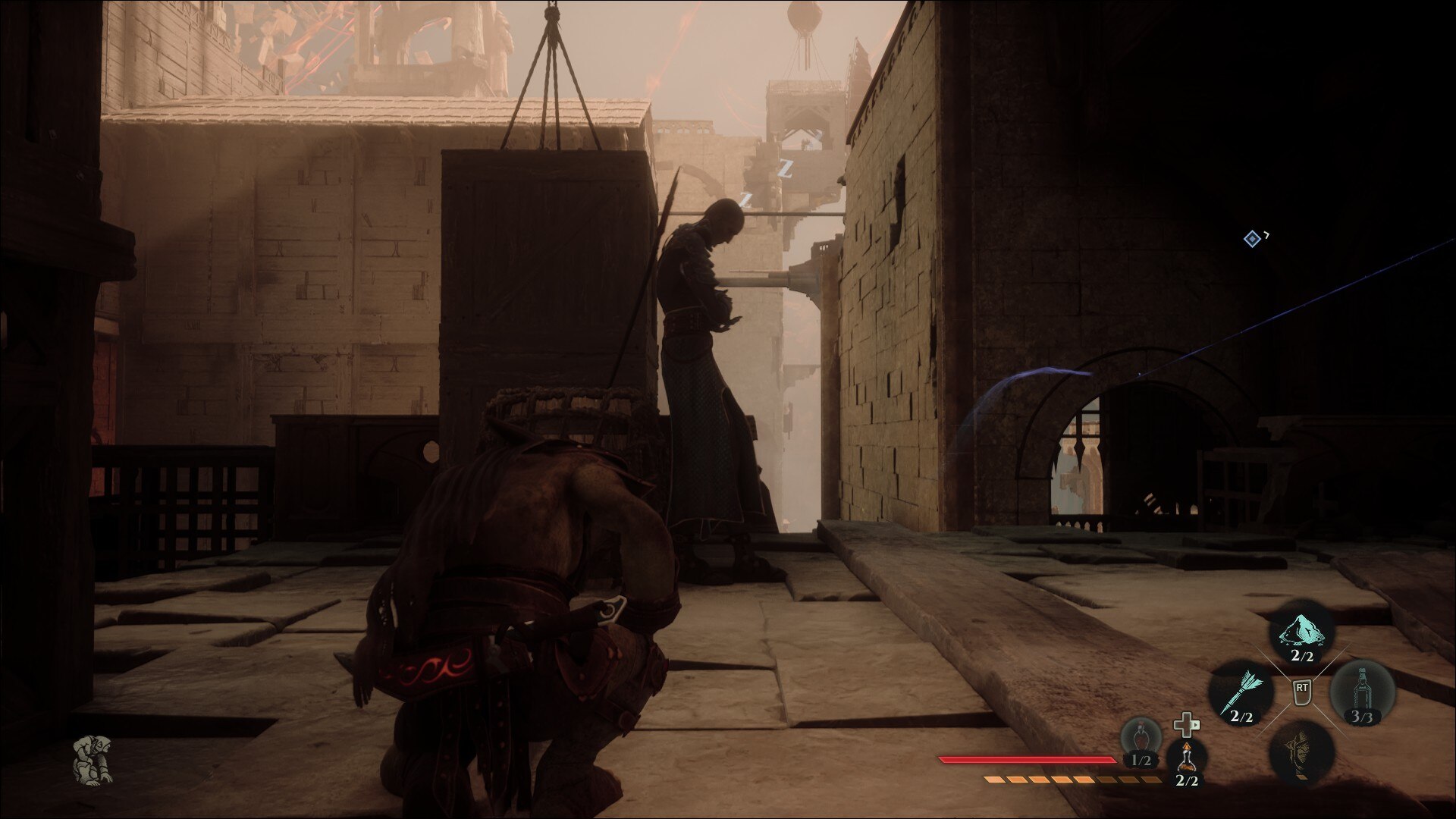
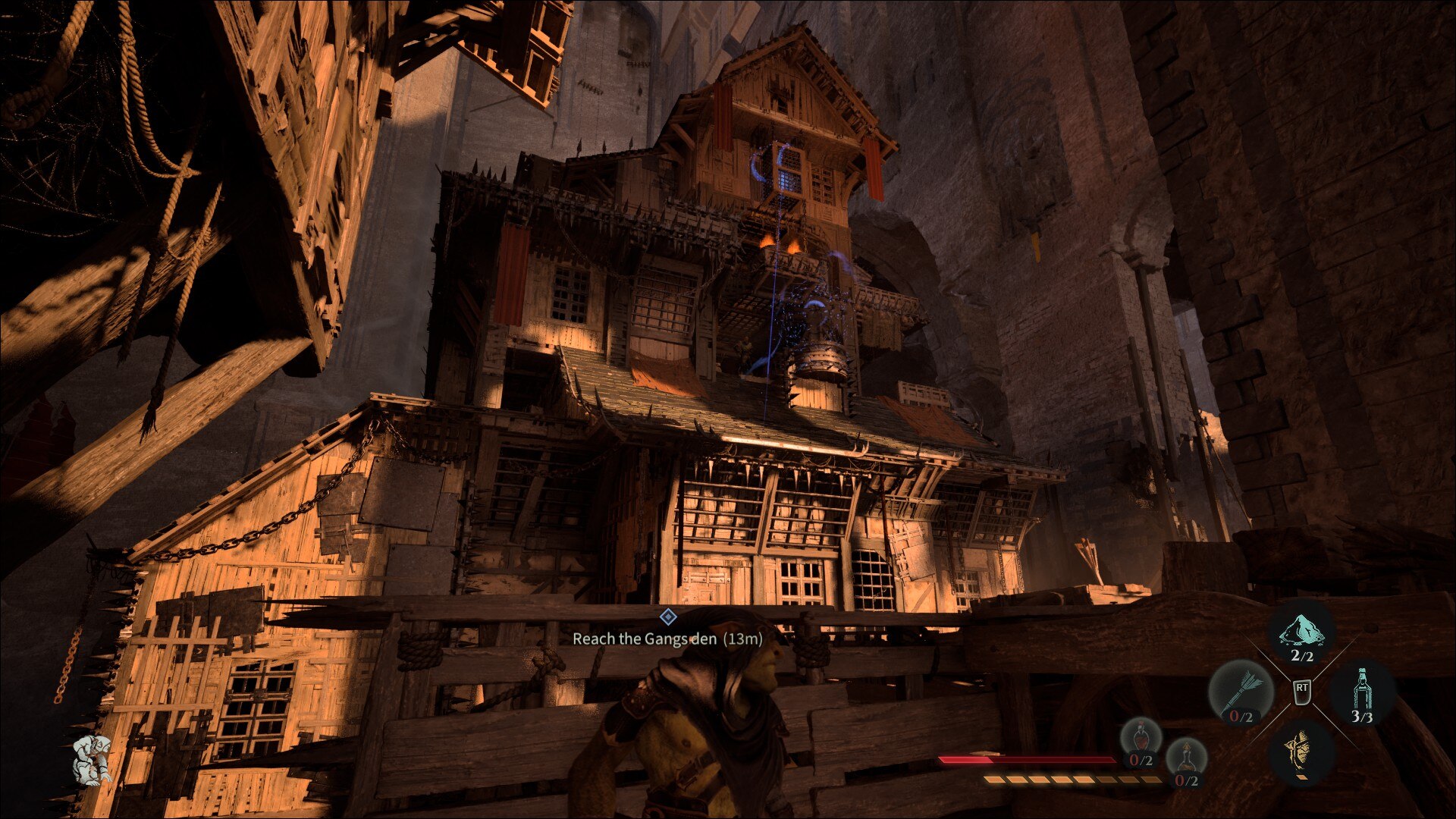
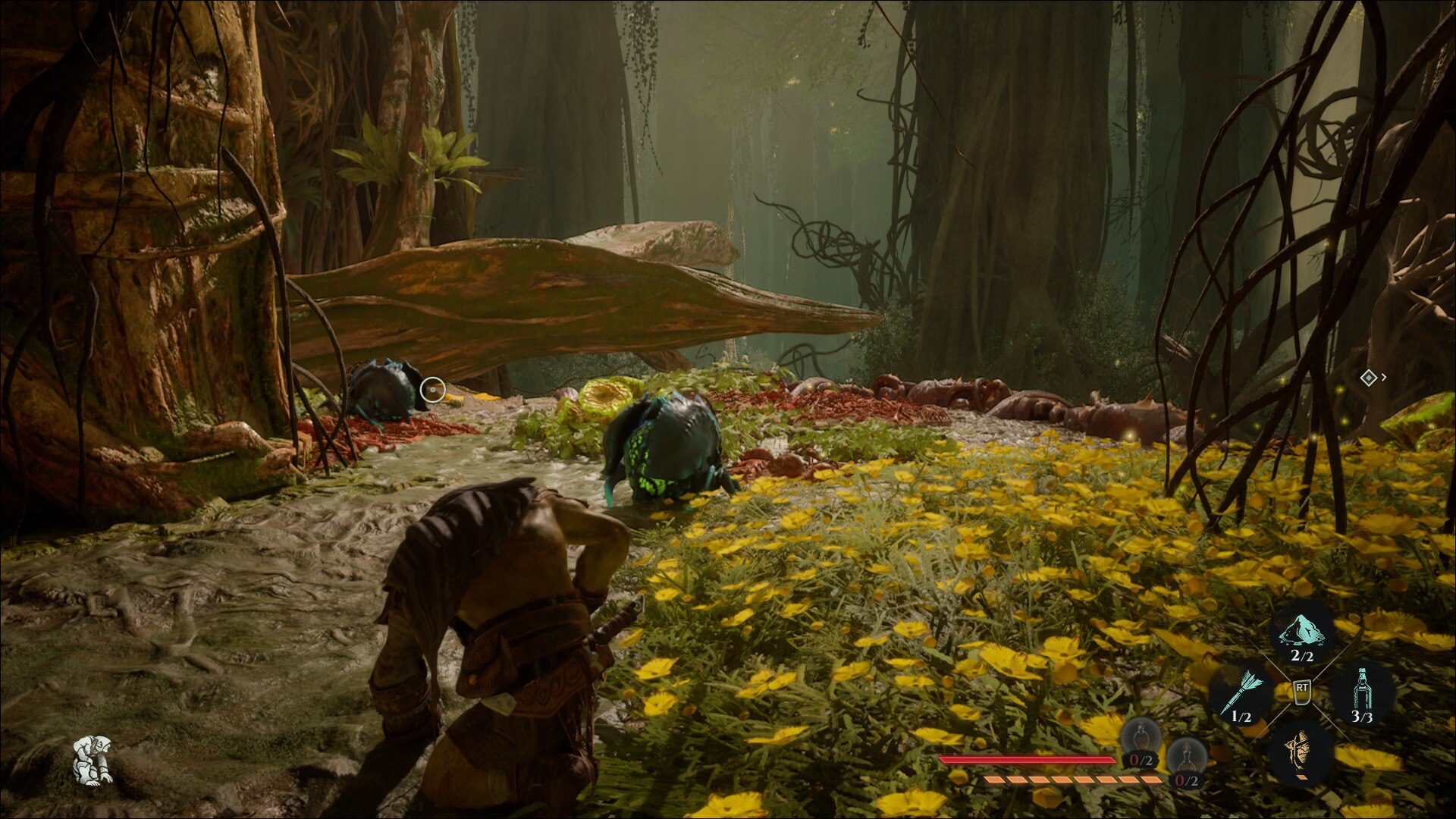
As a result, many of the story missions take the form of "go here and find three Quartz" and at first this seems boring. But Cyanide has embellished its worlds with puzzles and amusing obstacles in almost every instance, making each search for Quartz a discrete stealth narrative of its own. This is why I said before that the semi-open world structure hasn't really changed the Styx formula in a massive way: it still feels like a sequence of tightly constructed missions, there's now just a whole lot more choice regarding how you approach them.
Blades of Greed shaves away some of Styx's most tedious misanthropy and has him travelling between missions with a varied cast of fellow adventurers.
I did encounter problems though: during one Quartz hunt I needed to scale a seemingly insurmountable wall and, rather than simply climb it (which is what I ended up doing) I spent an hour fiddling around with a bunch of switches in the hope of lowering a bridge. It turned out these switches weren't relevant to me until a later mission, but I was compelled to keep trying because there are some actual bugs in Styx that undermined my confidence: keys that I couldn't pick up even though nearby enemies weren't on alert, entries that were sometimes accessible and other times invisibly blocked, and a quick save that only worked 95 percent of the time.
Performance was a little hairy on my RTX 3060 laptop, albeit stable. Unusually, I'd usually drop frames in busy bug-ridden interiors rather than the vast exteriors, but in a game this quiet and exacting I wasn't annoyed enough to turn settings down too low (and I really need to upgrade anyway).
Blades of Greed is a really good stealth game set in a meticulously detailed fantasy world. And oddly enough, by the end I didn't even hate Styx himself anymore. Blades of Greed shaves away some of Styx's most tedious misanthropy and has him travelling between missions with a varied cast of fellow adventurers. This sounds even more punishing on paper, but for the wider colour gamut and tonal variety I think this Styx game actually pulls off what I've thought the earlier games tried and failed: Blades of Greed feels like classic 1980s dark fantasy in the mould of The Dark Crystal, or Return to Oz. I still don't love Styx, but I think I know what Cyanide Studios was trying to do with him all along, and I think they've finally pulled it off.