Every so often, a TV talent announces themself to the world so clearly and obviously that the whole industry rises to meet them.
Job offers fly out of the trees. Networks open their checkbooks. Fans follow the star’s next move with bated breath.
This is not one of those stories.
There are many ways of understanding Johnson Wagner’s meteoric rise in golf from fringe pro to walking reporter for CBS, his new employers beginning this week at Torrey Pines. But perhaps the best way is to acknowledge Wagner for who he is: One of sports TV’s truest underdogs.
Wagner was not a social media celebrity when he was hired part-time at Golf Channel in 2022. He did not have a litany of major championship successes or a long history of compelling podcast interviews. Most weeks during his playing career, the most attention he generated was mild fascination with the jeans-brand phonetics of his name.
The anonymity wasn’t a dealbreaker for the network or the broadcaster. Golf Channel knew Wagner’s reputation as one of golf’s most affable pros. And, at 42 years old, Wagner wasn’t deluded about the “weight” of his “celebrity” after two decades and a handful of wins on the PGA Tour. He wanted only a shot to prove himself.
“My goal was to say yes to everything,” Wagner says. “I just wanted to be as useful and as productive as possible.”
The levity helped. Wagner’s first few days at Golf Channel were a challenge. He was uncomfortable in front of the camera. His analysis was placid and flat. He felt like he was struggling just to get the words out.
He was hardly the first. Many — if not most — athletes-turned-broadcasters struggle in the early oughts of a career in front of the camera. It makes sense: The subject matter might be familiar, but the discipline is new and the terrain is foreign. It’s generally hard to be humbled, but it’s harder when you’ve spent the vast majority of your life among the best in the world at your chosen profession. To confront both of those realities while standing before a national television audience? Well, it’s not hard to understand why so many athletes find retired life appealing after a year at the network.
Wagner wishes he could say he was undaunted by the early struggles — that his instincts as an entertainer took over without any coaxing — but that would be a lie. He survived those first few days not because he was better, but because he was willing to admit that he wasn’t. As he tried to gain his footing, he reached out to the TV pros around him (and beneath him) with an unusually candid question: Any advice?
“It was the day I fell in love with TV, and it was my third day at Golf Channel,” Wagner says, recalling the pep talk from a segment producer named Harris Chang that changed everything.
“We went out to dinner last night, we had a beer and we talked golf — that’s who we want to come across on air,” Chang told Wagner. “I don’t know if you’re trying to act like Brandel [Chamblee], but we just want you to be yourself.”
Wagner might have been within his rights to ignore such candid feedback from someone beneath him on the TV food chain. Instead, he thanked him.
“I took it to heart,” Wagner said.
It was a seminal moment for Wagner as a TV broadcaster, but maybe not in the way he thought. From that day forward, Wagner had earned a reputation as a consummate teammate — the kind of broadcaster who would go anywhere, tackle any assignment and handle any challenge with good humor. Across the industry, people noticed.
“I think what he brought out of his playing days into his broadcasting days was an element of vulnerability,” says Dottie Pepper, Wagner’s new teammate (and CBS’s lead walking reporter). “He did struggle with parts of the game and he never hid behind it. I think that’s going to be super valuable.”
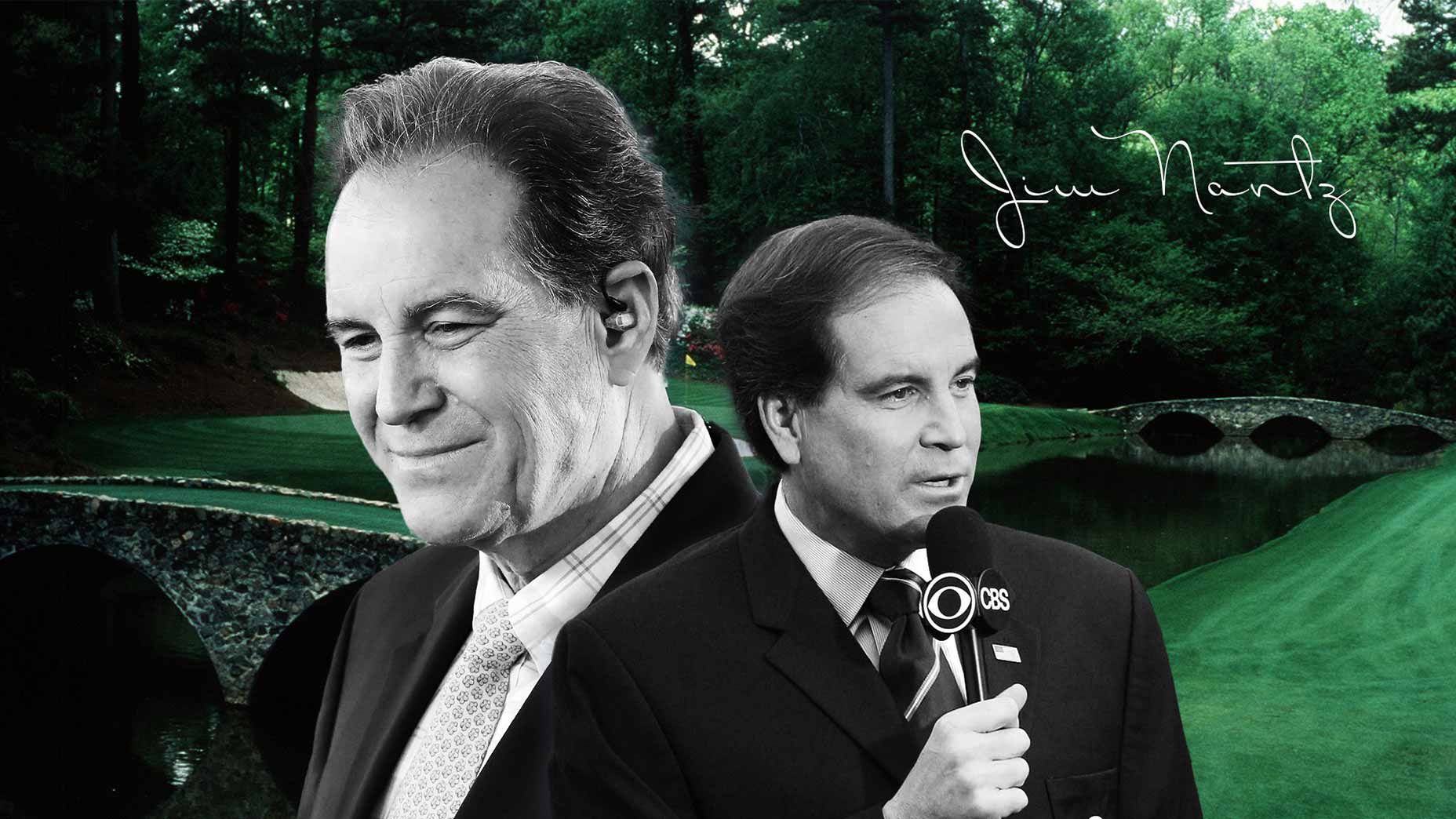
The only Masters story Jim Nantz won’t tell
For a long time, Wagner’s growth manifested quietly. Occasionally, fans or fellow Tour pros stopped him to share positive feedback (or, more frequently, admiration for his mustache).
Eventually, people caught on. Wagner’s voice was thoughtful and his analysis was studied and sincere. His teammates liked working with him. His bosses at Golf Channel were pushing him into larger roles.
Those tiny moments boiled over in the spring of 2024, when Golf Channel encouraged Wagner to try a new segment on Live From, recreating the most important moment of each day. (Years earlier, the idea had originated, to some success, with one of Wagner’s golf heroes — and now a CBS teammate — Frank Nobilo.)
The conceit was that Wagner’s analysis would take fans deeper into the difficulty of tournament golf shots and the skill level required to execute them, but the outcome wound up looking a lot like Bill Murray’s joke that every Olympic competition should include a normal person for reference. Wagner stepped in front of the camera looking serious and focused … and then he shanked a wedge shot. And then another. And then another. Until he’d flubbed so many that not even he could withhold his laughter. The video generated significant viral traction.
A few days later, Wagner was back in action after a curious Rory McIlroy drop. He nearly threw out his shoulder crow-hopping a golf ball into the side of a hill to recreate the situation. Another social media clip, another viral video. Then came the weekend. Another shank. More virality.
By the time he arrived at the U.S. Open at Pinehurst two months later, Wagner was a celebrity. By the end of the week — and after bettering Bryson DeChambeau’s heroic, tournament-winning bunker shot late on Sunday evening — he was a folk hero. The TV industry took notice. At long last, Wagner was on the up-and-up … and ready for it.
“There were moments in my playing career where I maybe got a little lazy, when things felt easy. So when I started out with TV, I wanted to climb as high as I possibly could,” Wagner says. “I know I don’t have the credentials to be a Johnny Miller or Trevor Immelman. But I want to be the best that I can be.”
Of course, the irony is that Wagner’s everyman credentials are essential to his viral success. The mishaps have arrived organically, but they are funny only because Wagner isn’t a major champion. Without Wagner’s sense of self, his segments might have welcomed cringes rather than chuckles. His relatability is his essence.
“He’s shown vulnerability in his Live From segments, [he showed it] reaching out for help when he first got into broadcasting,” Pepper says. “Vulnerability will be key as he continues to try to keep that polish going, because he’s gotten better, and better and better.”
In the end, the climax of Wagner’s TV underdog story wasn’t exactly Rudy. Ian Baker-Finch was retiring from his position in the CBS Golf booth, and Colt Knost was moving upstairs to replace him. That left a spot on CBS Golf’s team as the third walking reporter behind Pepper and Mark Immelman. Though Wagner had only been a walking reporter a handful of times at Golf Channel and NBC, CBS was interested in what they’d heard and seen. An offer arrived, and Wagner accepted.
“I still can’t believe it,” Wagner says now. “Three years ago, I was starting in TV. Now I’m with CBS. It’s unbelievable.”
Fear not, golf fans — as part of his job with CBS, Wagner will be bringing his Live From segments with him. He says the exact dimensions of those efforts are still taking shape, but their importance in Wagner’s promotion is hard to ignore.
“If it weren’t for my role on Live From, I don’t think there was any way that I would have been considered for this job,” Wagner admits. “It’s definitely made me who I am in broadcasting, and interacting with fans at major championships, it’s shocking that they know who I am and that they love watching me.”
Shocking to him maybe, but not to everyone else. If you want to know what makes Wagner a fit for this promotion — and for the jobs that will come after it — you don’t need to understand broadcast nuance or on-air skill.
Only a far more human superpower: humility.
“I have to prove myself,” He says. “I don’t want to get complacent in a role and think, I’m too good for this, or I’m too good for that. To start at the beginning again with a new station, with a new company — that’s what keeps me motivated right now.”
The post CBS Golf’s newest voice has an unorthodox superpower appeared first on Golf.