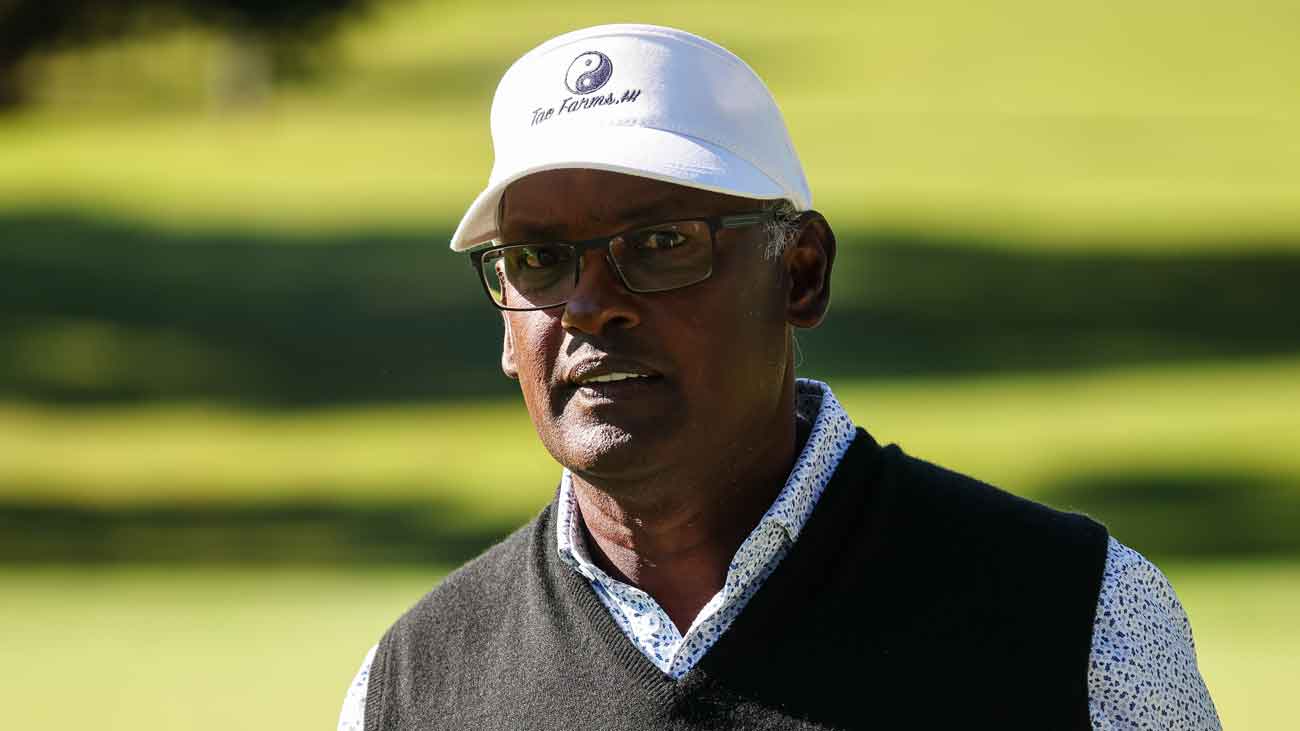
The most interesting result of the first week in the PGA Tour’s new season came from a golfer who was not in contention: Vijay Singh’s tie for 40th place at the Sony Open in Honolulu — at age 62. He didn’t have enough putting game last week to top-10 and likely doesn’t have enough putting game to contend in any PGA Tour event, not at the moment. That won’t stop him from trying. The opposite.
Singh is the personification of will. He is a testament to the benefits of relentless dedication to craft. More than any other golfer this side of Ben Hogan and maybe including Ben Hogan, Singh turned practice sessions into public displays of meditation and mindfulness. Not that Singh would ever use such words. If Singh had to choose between “manifestation” and “be the ball,” he’s going with b-t-b.
But what Singh has really been doing, all these years, is hitting so many balls he has been able to play with something approaching mindlessness. That is, cutting your swing thoughts from a manageable number (one) to the grail of all grails (nothing). A swing with no thoughts, no language, no anything but the swing’s whoosh. Dustin Johnson, at the height of his powers in 2018, was once asked what he thinks about during the swing, what his mind is doing. He said, “That’s a good question because I have no idea. Hopefully, it’s not really doing anything. When I’m actually hitting it, I’m not really thinking about anything.” For Singh, practice sessions is a time to make the swing more instinctive, more like walking, breathing, being.
Over the years, if you’ve gone to Tour events and senior events, you might have seen Singh’s former wife, his former girlfriend, his son and various players watch parts of his marathon range sessions as they went from one hour to two to three. (His caddies, and there have been many, have always been required to witness the entire thing.) Singh has a year-’round patch of grass to which he claims squatter’s rights on the back of the TPC Sawgrass range, not far from his home in South Ponte Vedra Beach, Fla. He once nearly came to blows when another player (his pal Rocco Mediate) encroached on it. Singh’s self-absorption can be stunning. It is also his superpower. It should also be noted, at times and over the years, that Singh has befriended players who had almost no chance of keeping their Tour cards but were nearly his match for devotion. He would practice beside such players, play practice rounds with them.
No non-American player has won more on the PGA Tour than Singh, who has 34 Tour wins. Rory McIlroy has 29. Gary Player has 24. He grew up in a working-class family in Fiji. He struggled in every way as a young pro. He was banned by the Asian Tour in 1985 over a cheating allegation. Singh has always denied the allegations, but it seems like it informed the rest of his professional life. He avoids talking to reporters when he can, is often curt or cranky, and his marathon range sessions, knowing his history, have looked like a sort of offering to golf. They seem consecrated, serious, important. It’s not like he’s just filling time. At 23, Singh was working as a club pro and a bouncer. At 43, he was inducted into the World Golf Hall of Fame. There were no other Hall of Famers playing last week in Hawaii.
He earned $31,522 there, bringing his lifetime Tour haul to $71,312,738, which puts him at eighth on the all-time PGA Tour career money list. Given that Singh has not played the Tour full-time for more than a decade, and that he was 30 when he played his rookie season, that’s north of astounding. Yes, he caught all the years when Tiger money flowed through the game, but not a penny of the LIV-inspired funny money. Maybe there will be some in his future. It’s not clear how many Tour events he will play in this year. An educated guess is a bunch. What’s going to make him feel more alive than trying to beat a collection of the best players in the world? Singh is a golfer, full stop.
He could easily pass the player now ahead of him on the career money list, Jim Furyk, before the year is out, as Singh uses a one-time exemption as a top-50 career money winner to play regularly this year. That exemption doesn’t get Singh into the small-field signature events and invitationals, but it gets him into most everything else. In theory, he could play his way into the Arnold Palmer Invitational and Players Championship and the Arnold Palmer Invitational. Those events are played on courses where he could top-10. He often played well at Bay Hill and won there once.
This 62-year-old is rejoining PGA Tour. Here’s the rule that enabled it
Singh is already in this year’s Masters, by virtue of his win there in 2000. Yes, there were tournaments in 2000 that were won by players other than Tiger Woods. There were a few players who represented a serious threat to peak Woods, most notably Ernie Els and Phil Mickelson. There was no player better equipped to handle the heat Woods generated than Singh.
In a 10-year period, from the start of 2000 through the end of 2009, the No. 1 ranked player toggled back and forth between Woods and Singh. Woods, Singh; Woods, Singh; Woods, Singh; Woods, Singh; Woods. Woods’s reigns were way longer, but those are the only two names on the top of the Official World Golf Ranking list for that decade. When Singh won at Bay Hill in 2007, Woods made a front-nine Sunday charge. “I wasn’t too concerned,” Singh said in victory. Woods faded away that Sunday.
To anybody who thinks that a 62-year-old Hall of Famer should not take a spot on the PGA Tour that could go to a player far younger and far needier, I say this: He’ll turn 63 before the Tour reaches Florida. He absolutely has earned the right to play the Tour. He’s not taking a spot from anybody. He’s claiming a spot that is his, that he has earned. The Tour has a rule that allows him to play, and he is taking advantage of it.
In 2005, Tom Kite, at age 55, took advantage of the same rule with an intention of playing a full season. He played in 12 events and made only three cuts. Amazingly, in one of those events, the old Kemper Open played at Congressional outside Washington D.C., Kite was tied for the lead through three rounds, then had a dismal Sunday. Kite was trying to do what Singh is trying to do, what innumerable people across the world are trying to do: slow down time. Singh will have the firepower to achieve more than Kite did more than 20 years ago. Is it an indictment of the senior tour that Singh is doing what he’s doing? Of course it is. Singh knows the best chance he has to raise the quality of his game is to play against the best players in the world.
When Padraig Harrington won the U.S. Senior Open in 2022, he won by a shot over Steve Stricker. Harrington’s four-day total was 274, 10 under par. When it was over, I asked Harrington what the scoring would have been had the field been comprised of the best players in the world and not the best senior players in the world. “It would have been lower, but I would have shot lower,” he said. It was such a telling answer.
It’s hard for reporters to engage Singh. When I first met him, I was a caddie and over the past 35 years he sometimes half tolerates me because he thinks of me more than a caddie than a reporter, but I’m not fooling myself here. In the fall of 2024, I found myself at a senior tour pro-am party on the driving range at Pebble Beach with Singh in attendance. I’ve typed this bit up before but now seems like a good place to take it out for some fresh air.
“Vijay, can I ask you one swing question?” I asked.
“Not now,” he said in his customarily dismissive way.
Not now is his reflexive answer to any question.
“Vijay, if not now, when?”
He half-nodded his assent.
I mentioned an evening session on the range I had seen at Carnoustie two months earlier, at the British Senior Open. He was there for two hours if not longer. I asked him what he had been working on. He was hitting driver after driver after driver. He answered immediately.
“My transition,” he said.
I, of course, cannot know if he was really referring to that specific session or, and more likely, to any session. (I’m sure he was trying to get rid of me, too.) Still, some answer: transition. A one-word driving-range swing thought. If you don’t finish the backswing, you can’t make a downswing.
I’m guessing the trick in Vijay’s golfing life is to go from the range, where you’re hitting it right on the face with the benefit of a single swing thought, and then play golf for real, golf on a golf course, and think about nothing at all. Playing golf with the delirious joy of an empty mind but also total purpose, total devotion. Maybe it can’t be done but a guy can go to his maker trying.
Michael Bamberger welcomes your comments at Michael.Bamberger@golf.com.
The post Vijay Singh, at almost 63, already has proven he’s PGA Tour-worthy (again) appeared first on Golf.