
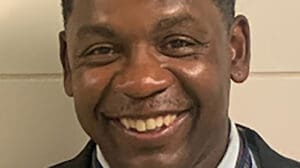
At every stage, his focus has stayed consistent: build sustainable systems that serve others long after the leader steps away.
“Success is defined by accomplishing the goals you have set,” Spencer says. “The measuring rod is not what you have done for yourself but those that you serve.”
That belief has shaped a long career in education leadership and operations.
Spencer was born in Jackson, Mississippi. When he was seven, his family moved to Long Beach, California. He was raised by a single mother, Clara Spencer, who played a central role in shaping his values around discipline, responsibility, and service.
As a student, Spencer stood out both academically and athletically. He was a scholar-athlete who lettered in football, baseball, and basketball. He earned all-league and all-county honors and played in multiple all-star games. He also held leadership roles early, serving as ninth- and tenth-grade class president and earning several oratory awards.
“I started working with youth as a mentor throughout high school and college,” he recalls. That early commitment to mentoring would later become a defining theme of his career.
Spencer went on to play collegiate baseball at Jackson State University and football at the University of California, Santa Barbara. He later earned a BA in Law and Society from UCSB and a Master’s degree in Education from Howard University.
Spencer began his professional career as a teacher, spending eight years in the classroom teaching social studies and coaching athletics. He also served as a department chair, balancing instruction with leadership responsibilities.
Teaching gave him firsthand insight into how policy decisions affect students and staff on the ground. It also sharpened his belief that leadership must be practical and people-centered.
“Believing that all children can learn and deserve a fair opportunity to be successful is non-negotiable,” he says.
Those years laid the groundwork for his transition into school administration.
Spencer spent more than two decades as a school leader, including eight years as an assistant principal and thirteen years as a secondary principal across multiple New York school districts. He led middle and high schools in both urban and suburban systems, many of them facing instability and entrenched challenges.
“I have worked in some of the most challenging and unstable educational systems in America,” Spencer says. “I had success by being able to listen, observe, and build the human capital capacity around me.”
As a principal, he designed and implemented expanded Advanced Placement access, Regents-level curriculum alignment, SAT and PSAT initiatives, mentorship programs, and enriched extracurricular offerings. These were not abstract strategies. They were built through collaboration with teachers, families, and students.
“I created smart goals while involving all stakeholders in decision-making,” he explains. “And I held everyone accountable, beginning with myself.”
One of Spencer’s strengths has been building partnerships beyond school walls. He worked closely with colleges, healthcare providers, law enforcement, and community-based organizations to expand student support services and real-world exposure.
His approach was structured and data-driven. “I look at what needs to be done first in order of priority,” he says. “I use a check-off system and revisit goals to build upon them.”
He also relied on evidence. “I use reliable statistical data to analyze outcomes,” Spencer explains. “I observe the quality of the product by using before and after metrics.”
This systems mindset made his work durable, even during leadership transitions.
Today, Spencer serves as Southern California Director of Operations for the William Law Foundation. In this role, he oversees after-school programs and childcare centers, ensures regulatory compliance, strengthens community partnerships, and supports grant development.
The position blends his background in education, operations, and community service. It also reflects his belief that leadership is about sustainability.
“Legacy matters more than accolades,” he says. “You have to be able to look in the mirror and know you did what was in the best interest of those you were responsible for servicing.”
Throughout his career, Spencer has emphasized personal accountability and honest reflection. When facing challenges, he focuses on control and preparation.
“I focus on what I can control in the moment,” he says. “I plan how to overcome challenges and what support systems I can call upon.”
He continues to surround himself with accomplished peers and seek direct feedback. “I ask for honest feedback while looking at the facts,” Spencer notes.
That mindset has kept his leadership adaptable across roles, regions, and systems.
Outside of work, Brodrick Spencer remains deeply involved in community service through voter registration drives, food and clothing programs, health education initiatives, youth mentorship, and senior partnerships. He is also a longtime member of Omega Psi Phi Fraternity Incorporated and active in faith-based and civic organizations.
For Spencer, success is not about titles or recognition. It is about impact that lasts.
“The sustainability of the systems you put in place matters,” he says. “Even when you are no longer present.”
That principle continues to guide his work as an education and operations leader, building systems that serve people first.
Read more:
Brodrick Spencer: Building Systems That Serve People