
NVIDIA and Lilly are putting together “a blueprint for what is possible in the future of drug discovery,” NVIDIA founder and CEO Jensen Huang told attendees at a fireside chat Monday with Dave Ricks, chair and CEO of Lilly.
The conversation — which took place during the annual J.P. Morgan Healthcare Conference in San Francisco — focused on the announcement of a first-of-its-kind AI co-innovation lab by NVIDIA and Lilly.
“We’re systematically bringing together some of the brightest minds in the field of drug discovery and some of the brightest minds in computer science,” Huang said. “We’re going to have a lab where the expertise and the scale of that lab is sufficient to attract people who really want to do their life’s work at that intersection.”
The initiative will bring together Lilly’s world-leading expertise in the pharmaceutical industry with NVIDIA’s leadership in AI to tackle one of humanity’s greatest challenges: modeling the complexities of biology. The two companies will jointly invest up to $1 billion in talent, infrastructure and compute over five years to support the new lab, which will be based in the San Francisco Bay Area.
During the fireside chat, Ricks reflected on the painstaking work of drug discovery and AI’s potential to transform the cycle of pharmaceutical invention.
“Each small molecule discovery is like a work of art,” he said. “If we can make that an engineering problem, versus this sort of discovery, this artisanal drug-making problem, think of the impact on human life.”
The lab will operate under a scientist-in-the-loop framework, where agentic wet labs are tightly connected to computational dry labs in a continuous learning system. This framework aims to enable experiments, data generation and AI model development to continuously inform and improve one another.
“Machines are made to work day and night to solve this problem,” Ricks said.
The co-innovation lab builds on Lilly’s previously announced AI supercomputer — the biopharma industry’s most powerful AI factory, an NVIDIA DGX SuperPOD with DGX B300 systems — which will train large-scale biomedical foundation and frontier models for drug discovery and development.
By integrating AI into drug discovery, Ricks explained, pharmaceutical researchers can rapidly simulate a massive number of possible molecules, test them at scale in silico and filter out promising candidates. The next challenge is to find more biological targets using AI.
“The holy grail is that you put those two things together, and we can model the whole system at once,” Ricks said.
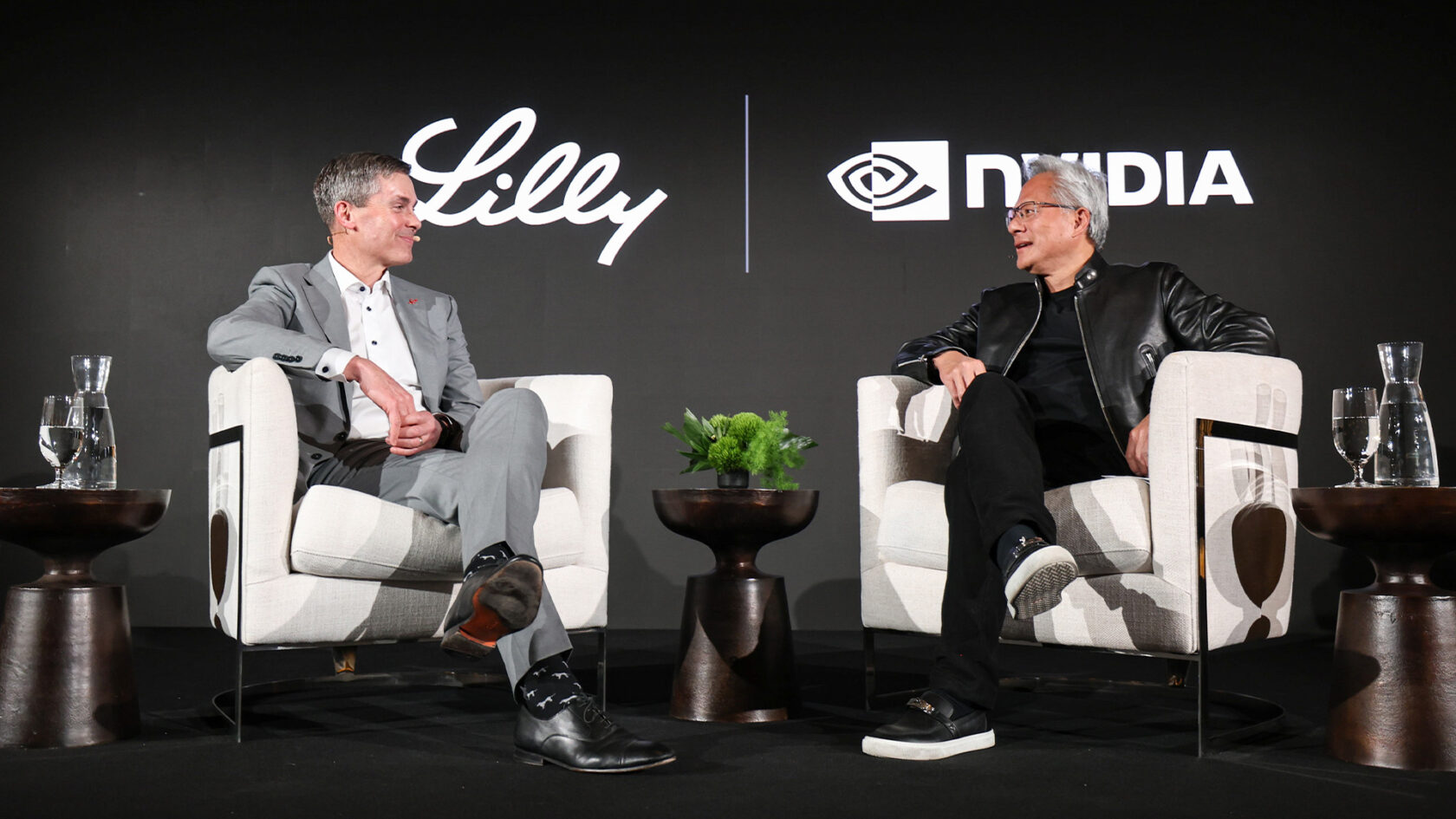
Huang and Ricks also discussed Lilly’s long history of harnessing computing for pharmaceutical research — and how diseases of the aging brain are the next frontier for drug discovery.
“I can’t imagine a more worthy field to apply computer science to,” Huang said. “Hopefully we can bend the arc of history.”
NVIDIA’s full-stack AI platform is accelerating the creation and deployment of leading foundation models across digital biology and drug discovery. To recognize some of the recent advancements, Huang raised a toast at J.P. Morgan Healthcare in honor of about a dozen leaders in the field — and the AI models they’ve pioneered.
“In the last 10 years, we’ve advanced AI 1 million times,” Huang said. “I believe that over the next 10 years, you will enjoy the same adventure that I’ve enjoyed in our generation … and so for each one of you — for your happy new year present and a thank you for everything that you do for the industry and for the future of humanity — I give to you a DGX Spark.”
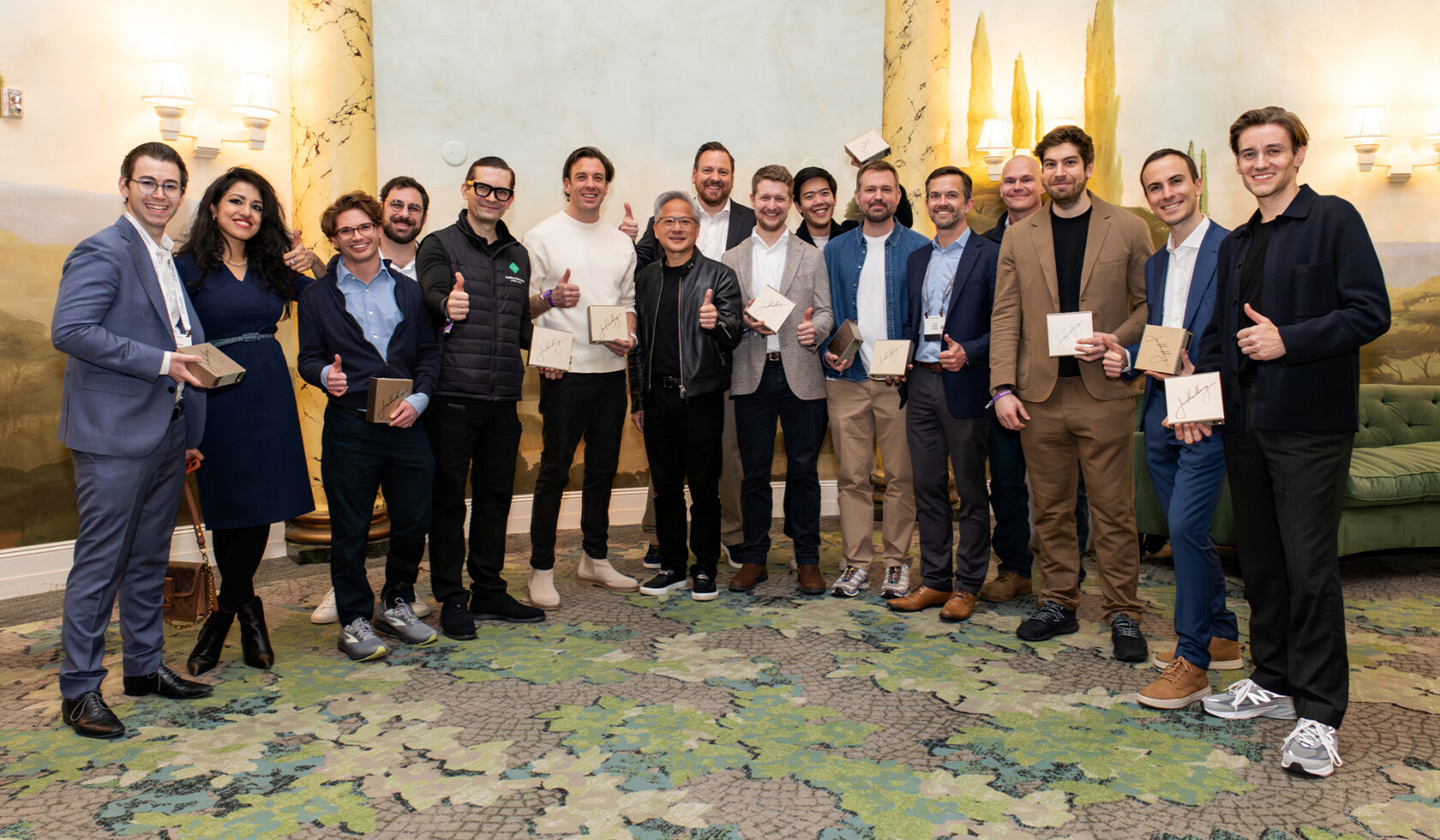
The honorees included:
At J.P. Morgan Healthcare, NVIDIA also announced a major expansion of the NVIDIA BioNeMo platform for AI-driven biology and drug discovery with tools including:
NVIDIA also highlighted a collaboration with instrumentation leader Thermo Fisher to build autonomous lab infrastructure using NVIDIA’s full-stack AI computing — and highlighted the work of Multiply Labs, a San Francisco-based startup that offers end-to-end robotic systems to automate cell therapy manufacturing at scale.
J.P. Morgan Healthcare is the world’s largest healthcare investment symposium, attracting over 8,000 global professionals including investors, policymakers and executives from across the healthcare industry.
For more from the conference, listen to the audio recording and view the presentation deck of a special address by Kimberly Powell, vice president of healthcare at NVIDIA, who discusses AI’s impact across healthcare.