Long before he put on the green jacket, I remember hearing Rory McIlroy say something surprising about memory.
It was early July 2024 at the Scottish Open, just weeks after his soul-crushing defeat to Bryson DeChambeau at the U.S. Open, and McIlroy was feeling understandably raw. He’d just had his heart ripped out in front of the entire golfing world, and thanks to the strange rhythms of the golf press, he would be forced to talk about it every day between then and the end of the following week’s Open Championship.
Given the obvious tension between the thing McIlroy clearly didn’t want to talk about and the thing I was professionally obligated to ask, I expected McIlroy to be defensive or combative. But when the topic of the U.S. Open arose, he was surprisingly plainspoken. McIlroy talked about the disappointment of losing, the decision to leave Pinehurst without a word, the few days he’d spent licking his wounds by disappearing into the ritualized chaos of New York City. And then, almost out of nowhere, he admitted something funny: He never planned to watch that U.S. Open again.
“I’ve watched back so much of my first U.S. Open win that I can’t remember the feelings I had,” McIlroy said. “Honestly, my memories of the U.S. Open at Congressional are through the TV, so I really try to do a good job of not watching anything back.”
McIlroy went on to say that he hoped to learn from his heartbreak at Pinehurst by reliving it himself, day after painstaking day, until he’d collected enough from the memories to ensure the outcome never happened again. It was an admirable pursuit. But I was struck by the broader sentiment: If the guy who ended the weekend at Congressional in 2011 with the trophy could have his memories of golfing glory flattened into the dimensions of a television screen, how could I hope to be any different?
I suppose this is a long way of admitting that I never plan to watch the 2025 Masters again. I witnessed it. I lived it. From the busy (and increasingly agonized) grounds of Augusta National, I missed a lot of it. But I know better than McIlroy knew his approach on 15 how it felt to watch McIlroy finish the golf story of a generation — and I never want to lose that feeling.
When my editors first approached me with the assignment to write about 2025’s significance in the greater Tao of golf, I snorted. Compared to the tectonic shifts of a sovereign-funded rival golf league, the ongoing melodrama of leadership, ownership, and sweet, sweet cash among golf’s playing class, and the fact that Tiger Woods had not played a single event, I felt pretty comfortable admitting that I didn’t just dislike the premise, I disagreed with it.
But then I thought about that Sunday afternoon in Augusta, and I remembered the things in golf that really matter don’t happen in a boardroom or a press release but in the memories too precious to forget. That’s what my great-great-great-grandchildren will remember from 2025 — and I’ll tell them the story straight from my own mind’s eye.
Over the course of a lifetime, you collect a lot of crap.
Like, for example, cliches — dozens or even hundreds of them — whispering about the magic of Sunday afternoon at Augusta National with the Masters on the line.
But it isn’t until you’re actually there, witnessing a truly magical Sunday afternoon at Augusta National, that it hits you like a semi-truck: Every last one of those cliches is absolutely and unquestionably true.
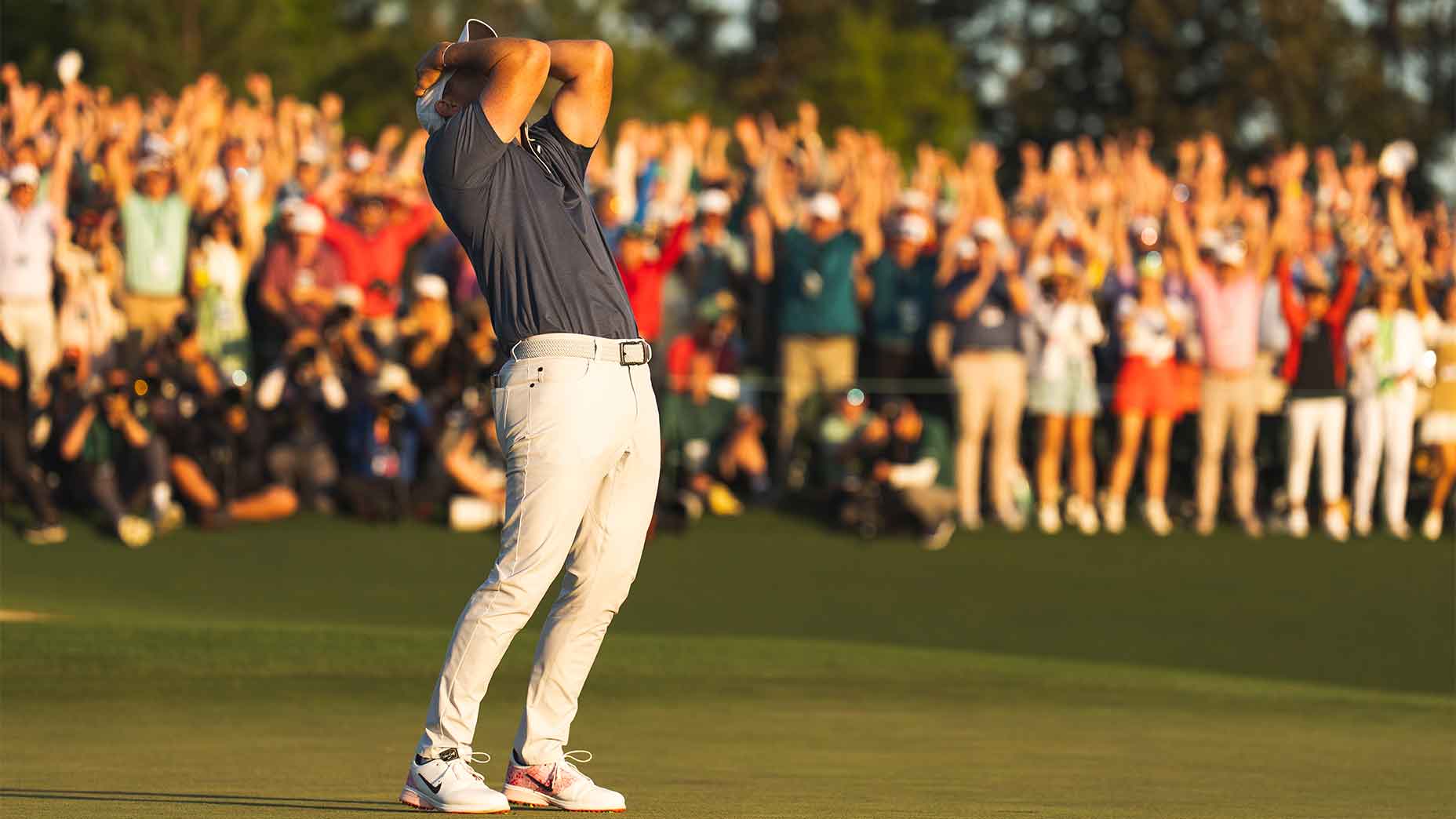
When people ask me about my memory from the ground in Augusta on Sunday afternoon at the 2025 Masters, the day that Rory McIlroy completed the career Grand Slam, that’s usually what I tell them.
1 striking Rory McIlroy Masters scene you missed on TV
If you’d spent the rest of your life crafting the screenplay for the story of Rory McIlroy’s triumph, you could not have picked a journey as cruel or an ending as nauseating as the story we witnessed at Augusta National. The swings — from a four-shot lead on the 10th hole to an inexplicable half-wedge into Rae’s Creek on No. 13, and from the miracle moonball on 15 to the unthinkable miss on 18 — were not believable. The ending was not believable. The tournament typified everything truly great about sports, which is that they are a story far better and far realer than any story concocted in the human brain. Sports are, in the most literal sense of the phrase, the ultimate drama.
That McIlroy’s win not only vanquished his decade-long demons, but did so at the one place that had tortured him most? That it required him to vanquish his old friend in Justin Rose and foe in Bryson DeChambeau? That it clinched McIlroy an irrevocable spot in golfing immortality? Well, that was just the gravy that took McIlroy’s win from great to historic.
Unfortunately, the balance of the universe argues we probably won’t see another Masters of 2025 levels of significance for some time. But we’ll always have 2025. Always.
It was fitting that McIlroy’s victory came just months before the PGA Tour he fought so hard to protect in the age of LIV hired new leadership.
In fact, Brian Rolapp’s hiring at the PGA Tour was one of three significant golf leadership changes we witnessed in 2025 — joining Scott O’Neil atop LIV and Craig Kessler atop the LPGA (and not including new USGA president Kevin Hammer or new PGA of America chief executive Derek Sprague).
Of course, it’s early to say exactly how these three men will perform, but it is not a stretch to suggest that all three face the opportunity to become the most transformative leaders in their respective tours’ history.
For Kessler, the question is: chicken or egg? The LPGA has grown steadily for years, but not at the rate or with the excitement of other major women’s sports. Can Kessler inspire a new generation of stars to attract fan attention far outside of golf? And can he amplify the Tour’s media presence significantly enough to change the bottom line? And which comes first?
For O’Neil, the question is relevance. Can he carry the league to major championship eligibility? And TV rights profitability? And sponsorship marketability? O’Neil has already stewarded in a new mindset for LIV relative to its competitors: complete, not compete. The unanswered question? If LIV, as currently constructed, can do either.
And for Rolapp, the question is expansion. Much has been made about his NFL pedigree and his schedule reorientation dreams, but his success in the job will be judged based on his ability to grow the pie of the PGA Tour for everyone. He has the best player in the world under his roof and the deepest pool of stars of any tour on earth. Is that enough to deliver a major return on investment? If it is, Rolapp could be remembered as the man who changed pro golf for good.
The post 2 reasons why 2025 was one of the most important golf years … ever appeared first on Golf.